Design3 min readBy Fuorix
Why Your Staff Hate the Software You Bought: UX for Internal Business Tools
The ERP is installed, the training is done, and everyone is still using WhatsApp and Excel. That is a design problem, not a discipline problem. What good UX looks like for internal tools and what it costs.
A distributor in Ajman spent a year's budget on an off-the-shelf ERP. Eight months later, the warehouse team was still writing stock on paper and one admin was typing it in on Thursdays. The software worked. Nobody wanted to use it.
Internal tools fail for predictable reasons: too many fields, screens designed for the vendor's demo rather than the person on the warehouse floor, no mobile version, and no Arabic. Every one of those is a design decision.
When we build a custom system we design for the slowest, busiest user first. That usually means a phone-friendly layout, big buttons for gloves and sunlight, three fields instead of fifteen, and defaults that match how the team already talks about the work. Design is included in every fixed-price project we quote, and standalone UI/UX work starts from $400. See UI/UX Design.
The rest of this article covers the evidence that design pays for itself, for customer-facing products and internal ones alike.
The $1 to $100 return on design investment
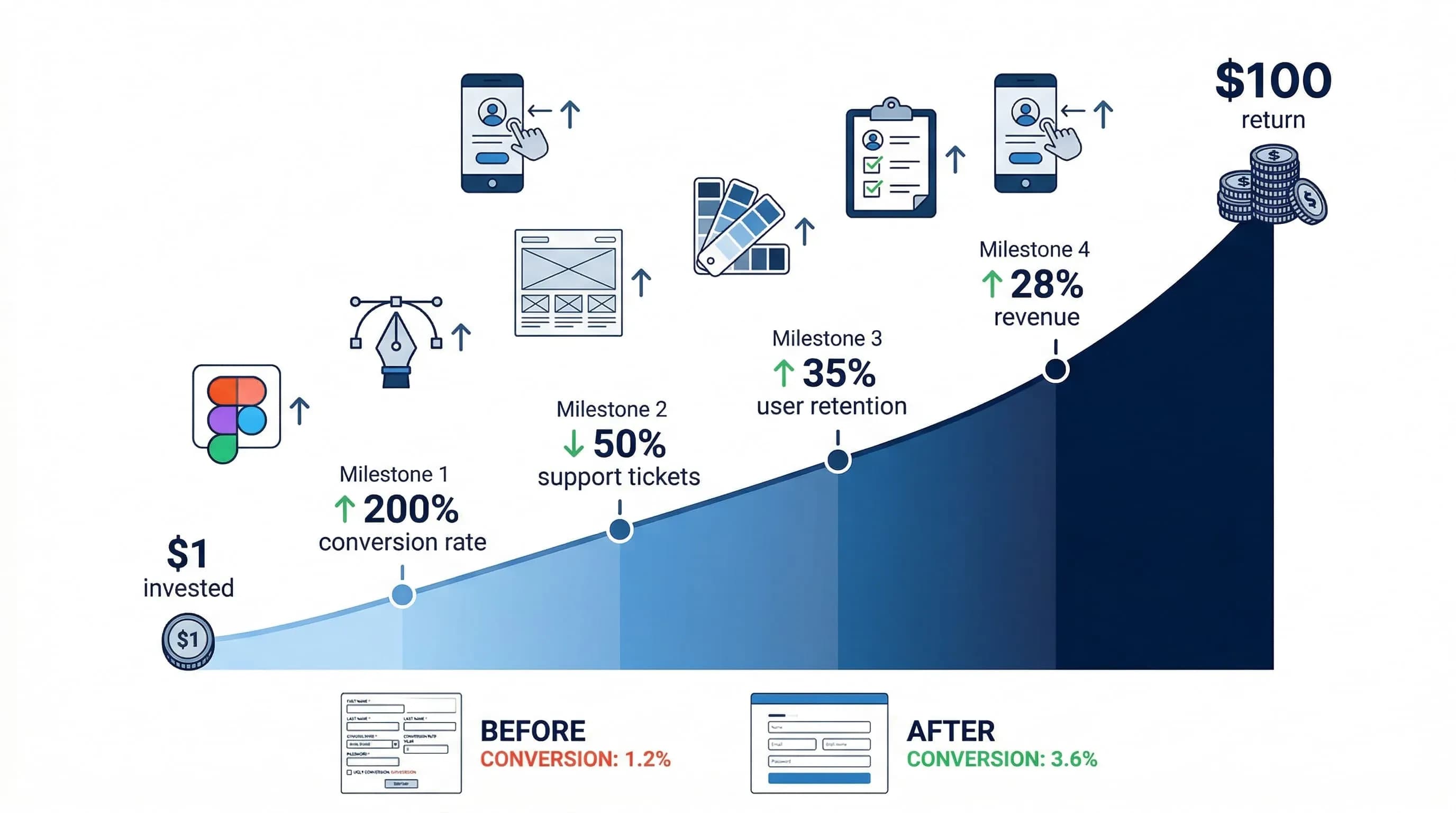
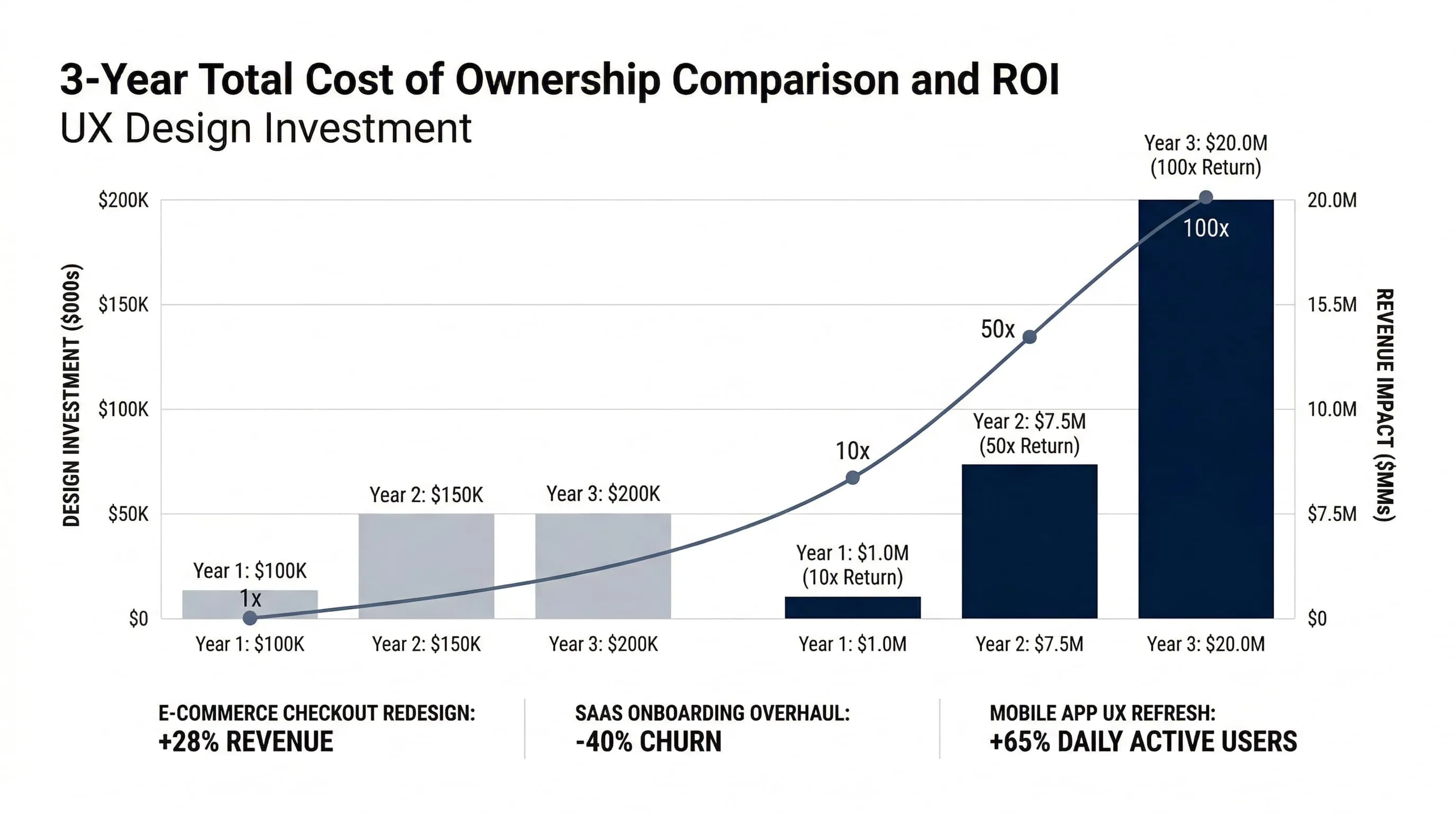
Forrester Research found that every $1 invested in UX returns $100 — a 9,900% ROI. This isn't aspirational; it's measurable. Better onboarding flows reduce churn. Clearer checkout flows increase conversion. Intuitive navigation reduces support tickets. Design isn't about making things pretty — it's about removing friction between your user and the outcome they're paying for.
 Every $1 invested in UX returns $100 according to Forrester Research
Case study: How a checkout redesign increased revenue by 28%
A client's e-commerce checkout had 6 steps, required account creation, and showed the total only on the last page. We redesigned it to 3 steps, added guest checkout, showed the running total throughout, and added trust indicators (security badges, return policy). Conversion rate jumped from 2.1% to 2.7% — a 28% increase that added $340,000 in annual revenue from existing traffic.
Usability testing: the cheapest insurance policy in software
A 1-hour usability test with 5 users catches 85% of UX issues (Nielsen Norman Group). Five 1-hour sessions cost approximately $2,000-3,000 including participant recruitment. Finding those same issues in production — after development, QA, and launch — costs 10-50x more to fix. We run usability tests at two points: after the prototype phase (before code) and after the beta launch (before scaling).
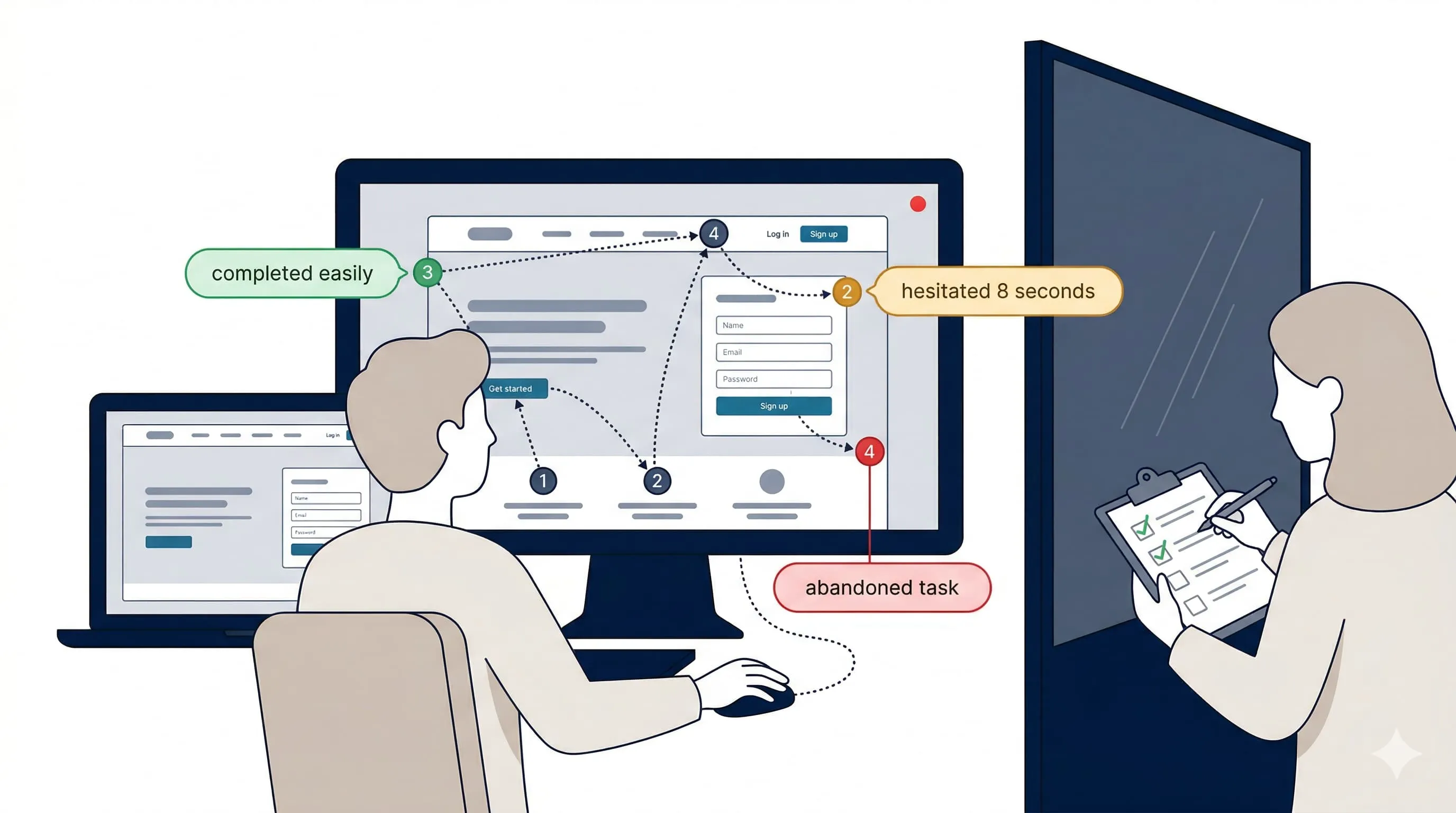 5 users catch 85% of usability issues — the cheapest insurance in software
Design systems save 30% of engineering time
Without a design system, every new feature requires designing components from scratch, developers interpret mockups inconsistently, and the product gradually becomes a patchwork of inconsistent patterns. A properly built design system — with component library, design tokens, spacing scale, and documentation — reduces design-to-development handoff time by 40% and eliminates 'this doesn't match the mockup' back-and-forth.
The cost of skipping design
We've inherited projects where design was skipped to save budget. The result: 3x the support tickets (users can't figure out the product), 50% higher churn (frustrated users leave), and 2x the development cost for v2 (redesigning and rebuilding features that should have been right the first time). Skipping design doesn't save money — it moves the cost to support, churn, and rework.
When to invest in design
Invest in UX design before writing code (prototyping phase), when conversion rates plateau despite increased traffic, when support tickets reveal recurring usability complaints, and when preparing for a funding round (investors evaluate product quality). Our design team combines user research with conversion optimization to create interfaces that measurably increase engagement and revenue. Contact us for a free UX audit of your current product.
Need help with this?
We build the systems described in this article. Let’s talk about your project.
Keep reading
Related articles
PricingFebruary 5, 2026
Custom Software Cost in 2026: Real Price Bands for UAE and UK Small Businesses
Forget the '$50,000 to $500,000' articles written for enterprises. Here are the fixed-price bands we quote small and mid-sized businesses in the UAE and UK, three worked examples, and the five things that move the price.
4 min read
Read article
StartupsJanuary 22, 2026
How Much Does an MVP Cost in 2026? Fixed-Price Examples from Real Builds
An MVP should cost a fraction of the full product, but only if it is scoped like one. Real price bands from marketplaces, SaaS tools and internal apps we have shipped, and the 12-week process behind them.
3 min read
Read article