Mobile Development3 min readBy Fuorix
React Native vs Flutter for a Small Business App: Cost, Timeline, Our Pick
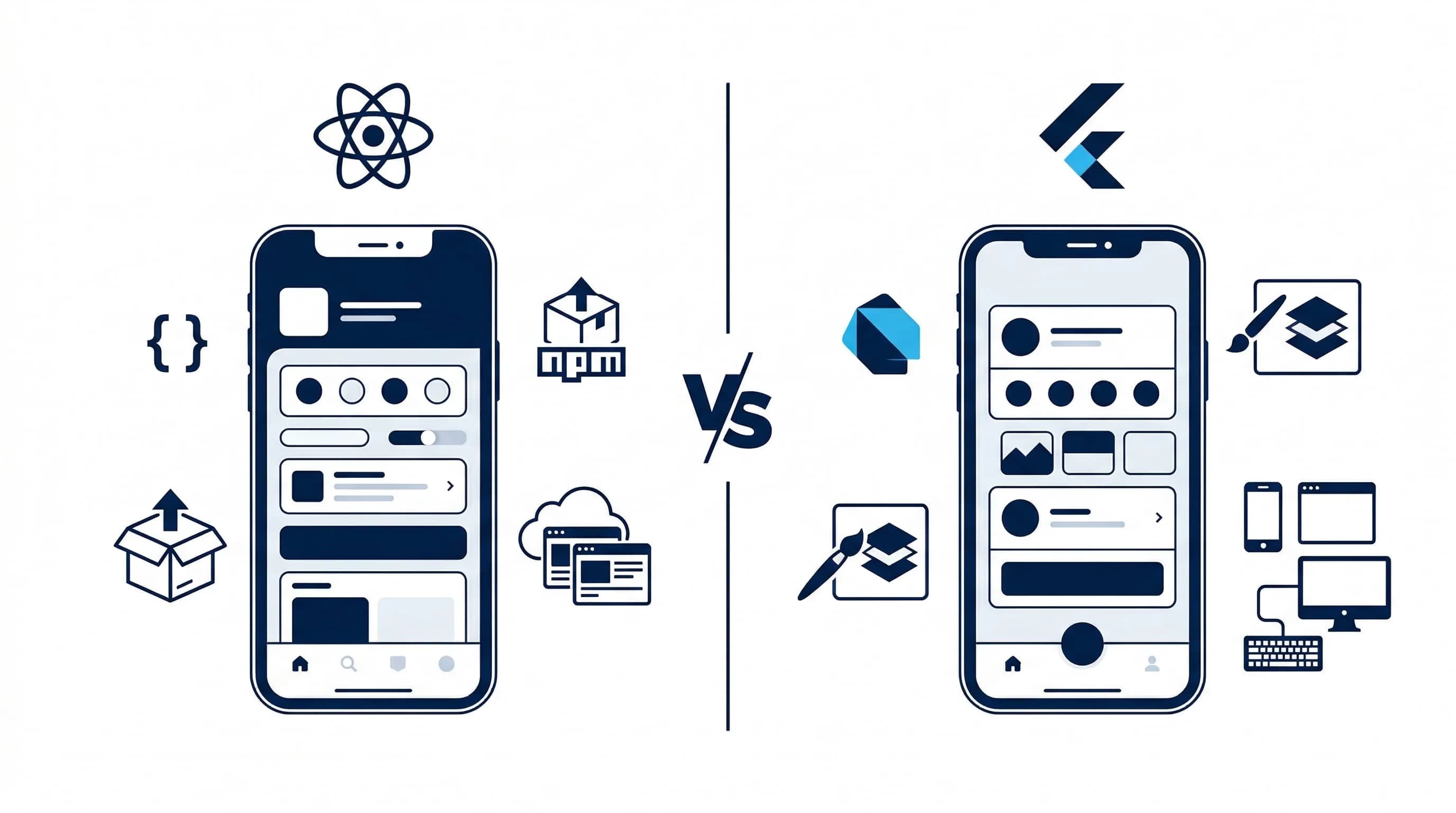
You do not need to understand the frameworks to make this decision. You need to know what each one costs to build, to run and to hire for. Here is our honest answer for small business apps, with prices.
You are a business owner, not a developer. You want an app for your customers or your staff, and someone has asked you whether you want it in React Native or Flutter. Here is what actually matters to you.
Cost. For a typical small business app (ordering, bookings, a staff tool, a loyalty app) both come out similar. Our mobile apps start from $800 (about AED 2,900 or £630) for a focused single-purpose app, with most business apps landing between $3,000 and $8,000.
Who will maintain it. React Native uses JavaScript, which almost every web developer knows. If you ever need someone else to take over, it is far easier to find them in Lahore, Dubai or London. This is why React Native is our default for SMB apps.
When we pick Flutter anyway: heavy custom animation, unusual UI, or a team that already runs Flutter.
If your app also needs a website and an admin panel, React Native lets us share code with the web app, which cuts the total price. See Mobile App Development or book a call to get a fixed quote. The detailed comparison follows.
The 2026 landscape: both frameworks are production-ready
In 2026, both React Native (with the New Architecture) and Flutter 3 are mature, performant, and backed by massive ecosystems. The choice is no longer about which framework is 'better' — it's about which fits your team, timeline, budget, and product requirements. We've shipped 15+ production apps with React Native and 5+ with Flutter across fintech, healthcare, logistics, and consumer categories.
 Both frameworks produce native-quality apps in 2026
Choose React Native when your team knows JavaScript
React Native's primary advantage is the JavaScript/TypeScript ecosystem. If your team already builds with React on the web, the learning curve is days not months. You can share business logic, API clients, and state management between web and mobile. The hiring pool for JS developers is 5-8x larger than Dart developers globally.
Choose Flutter when brand expression is the product
Flutter's Skia-based rendering engine draws every pixel directly, bypassing platform UI components entirely. This gives you pixel-level control over animations, transitions, and custom UI elements that's genuinely harder to achieve in React Native. Flutter 3's support for web, macOS, Windows, and Linux from a single codebase is also compelling.
Performance comparison in production
In our production benchmarks, React Native (New Architecture) and Flutter perform within 5-10% of each other for typical business applications. Flutter has an edge in complex custom animations. React Native has faster cold start times on Android by 200-400ms. For most business applications, neither framework will be the bottleneck.
Total cost of ownership analysis
React Native apps share code with your web platform (40-60% code reuse is typical), reducing maintenance to approximately 1.4x the cost of a single platform vs Flutter's 1.6x. React Native's npm ecosystem gives you access to 2M+ packages vs Flutter's pub.dev at 40K+ — meaning fewer features need to be built from scratch.
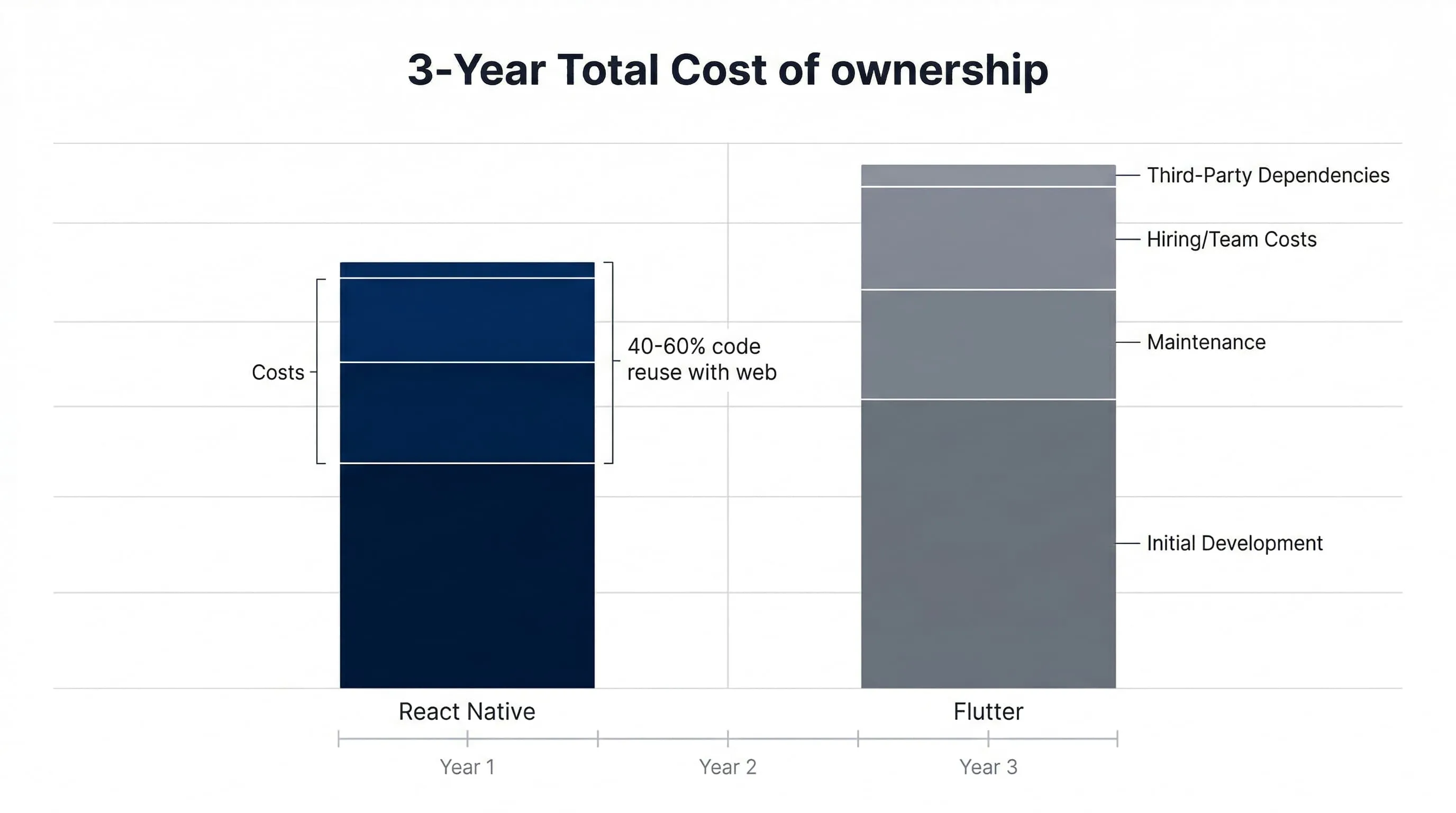 React Native offers lower total cost of ownership for web-first teams
Our recommendation based on 20+ shipped apps
For 80% of business applications — fintech, healthcare, logistics, e-commerce — React Native is the pragmatic choice. For consumer apps where animation quality is the primary differentiator, Flutter has a genuine edge. If you're evaluating frameworks for your mobile app, our team can build a proof-of-concept in both — contact us for a free technical assessment.
Need help with this?
We build the systems described in this article. Let’s talk about your project.
Keep reading
Related articles
Web DevelopmentMarch 28, 2026
Why We Build UAE and UK Business Websites in Next.js (and When We Don't)
Most of the business websites we ship for UAE and UK clients are built in Next.js. Here is what that means for your speed, Google rankings and hosting bill, and the three cases where we recommend something else.
3 min read
Read article
PricingFebruary 5, 2026
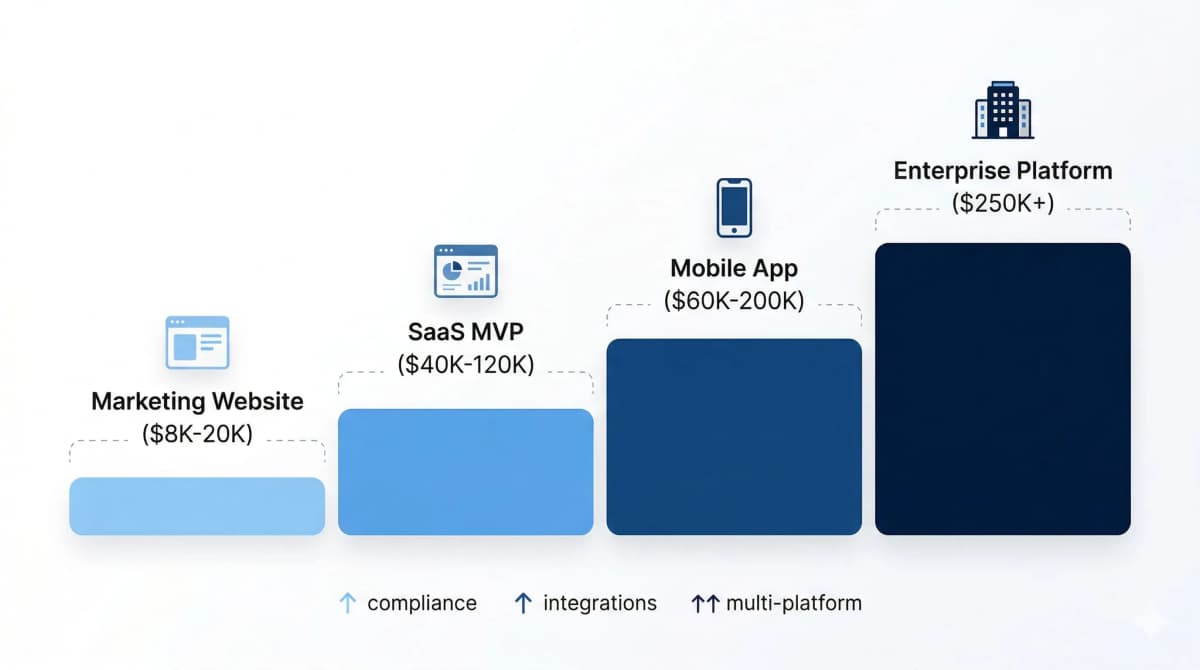
Custom Software Cost in 2026: Real Price Bands for UAE and UK Small Businesses
Forget the '$50,000 to $500,000' articles written for enterprises. Here are the fixed-price bands we quote small and mid-sized businesses in the UAE and UK, three worked examples, and the five things that move the price.
4 min read
Read article